https://www.youtube.com/watch?v=NeHZcwCUPFg
Disjoint Cycle Theorem, Cycle Sort, and Minimum Swaps to Sort
1. The Core Idea: An Array as a Permutation
Whenever you have an array of distinct elements, you can think of it as a permutation — a function that maps “current position” to “correct (sorted) position.”
Example array:
index:   0   1   2   3   4
arr:    [4,  3,  2,  1,  0]
Sorted version: [0, 1, 2, 3, 4]
For each index i, define:
pos(i) = the index where arr[i] should end up in the sorted arrayFor the array above (values happen to equal 4 - index), the sorted target index of value v is just v itself. So:
pos(0) = 4   (arr[0]=4 belongs at index 4)
pos(1) = 3   (arr[1]=3 belongs at index 3)
pos(2) = 2   (arr[2]=2 belongs at index 2)
pos(3) = 1
pos(4) = 0
This pos function is a permutation of {0,1,2,3,4}. Everything below follows from analyzing this permutation.
2. The Disjoint Cycle Theorem
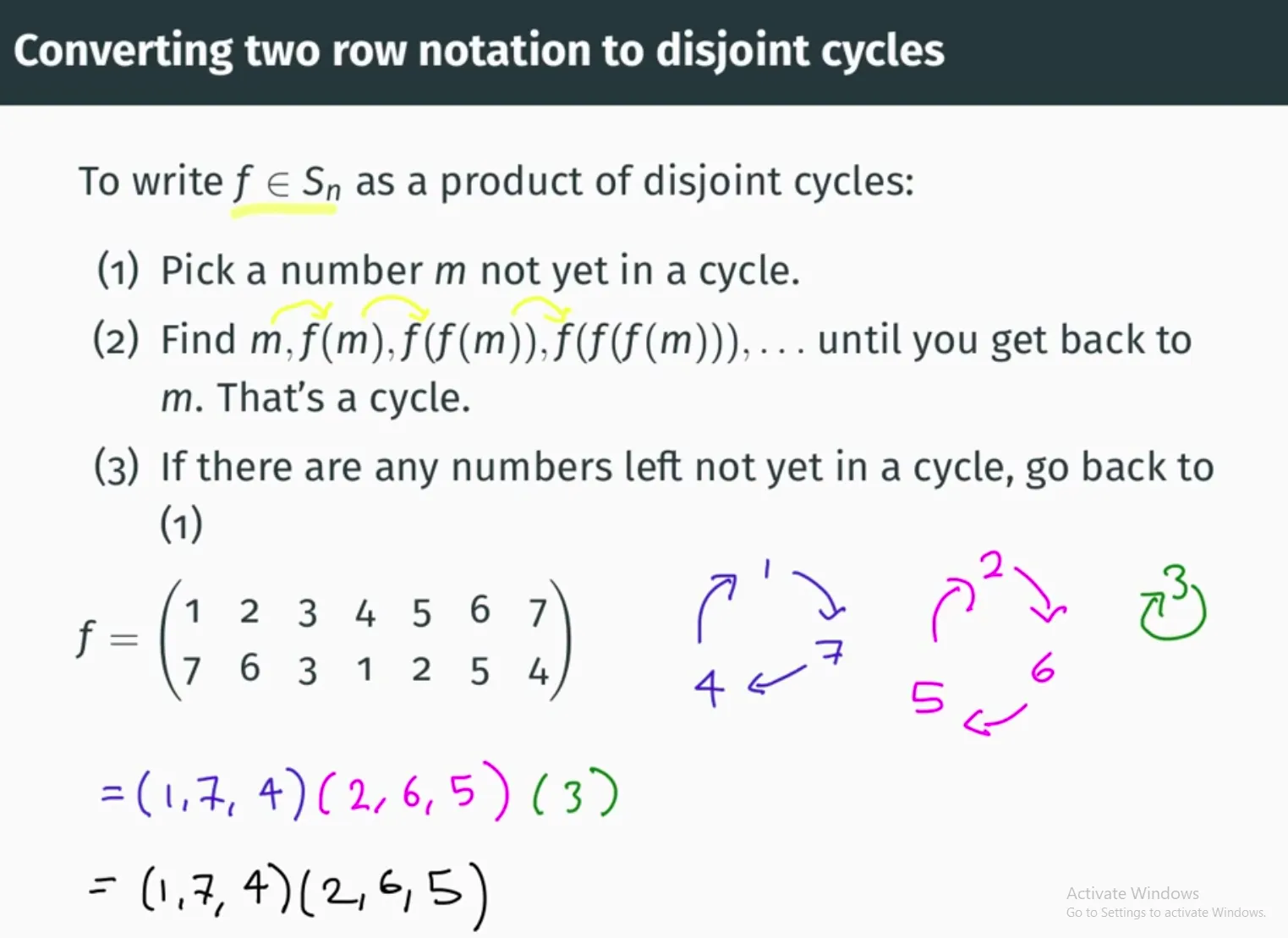
Theorem: Every permutation of a finite set can be decomposed into disjoint cycles, and this decomposition is unique (up to the order in which you list the cycles and the starting point within each cycle).
What is a cycle here? Start at any index i. Follow the chain:
i → pos(i) → pos(pos(i)) → pos(pos(pos(i))) → ...Since pos is a permutation on a finite set, this chain must eventually return to i (it can’t go on forever without repeating, and the first repeat must be i itself — otherwise pos wouldn’t be injective). The indices visited before returning form a cycle.
Why disjoint? If two cycles shared an index, following pos forward from that shared index would force the rest of both cycles to be identical (since pos is a function — each index has exactly one image). So cycles either are identical or share nothing.
Worked Example
index:   0   1   2   3   4   5
arr:    [3,  5,  4,  0,  1,  2]
sorted: [0,  1,  2,  3,  4,  5]
Compute pos(i) = index in sorted array where arr[i] belongs (since values are 0..n-1, pos(i) = arr[i]):
pos(0) = 3
pos(1) = 5
pos(2) = 4
pos(3) = 0
pos(4) = 1
pos(5) = 2
Trace cycles:
- Start at 0:
0 → 3 → 0→ cycle(0 3), length 2 - Start at 1 (unvisited):
1 → 5 → 2 → 4 → 1→ cycle(1 5 2 4), length 4
So the permutation decomposes into two disjoint cycles: (0 3) and (1 5 2 4), covering all 6 indices exactly once. That’s the Disjoint Cycle Theorem in action.
Cycle notation reminder: (1 5 2 4) means: element at position 1 moves to position 5’s slot, element at 5 moves to 2’s slot, element at 2 moves to 4’s slot, element at 4 moves back to 1’s slot.
3. Why a Cycle of Length k Needs Exactly k − 1 Swaps
This is the heart of the connection to sorting.
Intuition
Think of a cycle as a closed loop of “IOUs”: the value sitting at position a1 actually belongs at position a2; the value at a2 belongs at a3; …; the value at ak belongs back at a1.
A single swap can only exchange two elements. Each swap you perform, if done wisely, permanently fixes at least one element into its correct final position and shortens the remaining unsorted cycle by exactly one.
Formal Argument
Take cycle (a1 a2 a3 ... ak). Swap the elements at positions a1 and a2:
- The element formerly at
a1(which belonged ata2) is now correctly placed ata2. ✅ Locked in — never touched again. - The element formerly at
a2is now sitting ata1.
The remaining unsolved structure is now the cycle (a1 a3 a4 ... ak) — length k − 1.
Repeat: each swap reduces cycle length by exactly 1, and locks exactly one element in place. You keep going until the cycle has length 1 (a single element left, which is now automatically correct — a length-1 “cycle” needs 0 swaps).
Length k --swap--> Length k-1 --swap--> ... --swap--> Length 1 (done)Total swaps = k − 1.
Why can’t you do it in fewer?
Each swap moves at most 2 elements. Before any swaps, zero elements of this cycle are in their correct spot (by definition of a nontrivial cycle — every element in a cycle of length ≥ 2 is displaced). Each swap can fix at most one new element permanently (the other element touched is merely relocated, not necessarily finalized, until the last swap when both land correctly). So to fix k elements you need at least k − 1 swaps — matching the upper bound above. Hence k − 1 is both necessary and sufficient.
Example: cycle (1 5 2 4), k = 4
Positions:  1    5    2    4
Values: 5 2 4 1 (value at pos1 belongs at pos5, etc.)- Swap pos1 ↔ pos5: value
2locks at pos5. Remaining cycle:(1 2 4) - Swap pos1 ↔ pos2: value
4locks at pos2. Remaining cycle:(1 4) - Swap pos1 ↔ pos4: value
1locks at pos4, and value1(the last one) also lands correctly at pos1. Done.
3 swaps for a cycle of length 4 → k − 1 = 3. ✔
General Formula for the Whole Array
If a permutation decomposes into cycles of lengths k1, k2, ..., km (a fixed point — an element already in its correct place — counts as a cycle of length 1, contributing 0 swaps), then:
Minimum swaps to sort the whole array = Σ (ki − 1) = (Σ ki) − m = n − mwhere n = total elements, m = total number of cycles (including trivial length-1 ones).
In our 6-element example: cycles (0 3) [k=2] and (1 5 2 4) [k=4] → total swaps = (2−1) + (4−1) = 1 + 3 = 4. Also checks out via formula: n − m = 6 − 2 = 4.
4. Connecting This to Cycle Sort
Cycle Sort is a comparison-based, in-place sorting algorithm whose defining feature is: it performs the theoretical minimum number of writes/swaps needed to sort the array — because it explicitly walks each disjoint cycle and rotates it in exactly k − 1 writes, never touching an element more than necessary.
Algorithm
def cycle_sort(arr):
    n = len(arr)
    writes = 0

    for cycle_start in range(n - 1):
        item = arr[cycle_start]

        # Find where 'item' belongs: count elements smaller than it
        pos = cycle_start
        for i in range(cycle_start + 1, n):
            if arr[i] < item:
                pos += 1

        if pos == cycle_start:
            continue  # already in correct place, 0 writes for this cycle element

        # Skip over duplicates
        while item == arr[pos]:
            pos += 1

        arr[pos], item = item, arr[pos]
        writes += 1

        # Rotate the rest of the cycle
        while pos != cycle_start:
            pos = cycle_start
            for i in range(cycle_start + 1, n):
                if arr[i] < item:
                    pos += 1
            while item == arr[pos]:
                pos += 1
            arr[pos], item = item, arr[pos]
            writes += 1

    return arr, writes
Why this is the disjoint cycle theorem in code
cycle_startiterates over indices, same as tracingiin Section 2.- The inner “find pos” step computes exactly
pos(i)— where the current item belongs in sorted order (via counting, instead of a precomputed sorted-index map). - The
while pos != cycle_startloop is literally walking the cycle(a1 a2 a3 ... ak)one step at a time. - Each iteration of that inner loop performs one write/swap, and the loop runs exactly
k − 1times beforeposreturns tocycle_start— precisely matching Section 3’s proof. - Elements already forming a length-1 cycle (
pos == cycle_start) cost 0 writes — thecontinuestatement.
This is why Cycle Sort is prized in situations where writes are expensive (e.g., writing to flash memory/EEPROM) — it achieves the information-theoretic minimum of n − m writes, exactly the quantity derived in Section 3.
Trade-off: Cycle Sort’s comparisons are still O(n²) in the worst case (the “count smaller elements” step), so it’s not faster than O(n log n) sorts in terms of comparisons — its selling point is minimal writes, not minimal time.
5. Connecting This to “Minimum Swaps to Sort an Array” (the classic problem)
This is a very common interview/competitive-programming problem:
Given an array of
ndistinct integers, find the minimum number of swaps required to sort it (arbitrary swaps allowed between any two indices, not just adjacent).
Key realization: This is exactly asking for Σ (ki − 1) = n − m from Section 3 — you don’t even need to simulate the sort; you just need the cycle decomposition.
Algorithm
- Pair each value with its original index:
(value, original_index). - Sort these pairs by value → this tells you, for each position, where the element currently sitting there needs to go.
- Build a
visited[]array. - For each unvisited index
i, walk the cycle it belongs to (following “where does the element that should be at positionicurrently sit”), marking visited nodes, and counting cycle lengthk. - Add
k − 1to the answer for that cycle. - Sum over all cycles.
Code
- due to sorting
values would be distinct is an important assumption here . Without that it becomes a much harder problem. Values don’t need to be in range of 0 to n-1. We are coordinate compressing Coordinate Compression
def min_swaps_to_sort(arr):
    n = len(arr)
    # (value, original_index), sorted by value
    indexed = sorted(range(n), key=lambda i: arr[i])
    visited = [False] * n
    swaps = 0

    for i in range(n):
        if visited[i] or indexed[i] == i:
            continue  # already correctly placed / already counted

        cycle_len = 0
        j = i
        while not visited[j]:
            visited[j] = True
            j = indexed[j]
            cycle_len += 1

        swaps += (cycle_len - 1)

    return swaps
Worked Example
arr = [4, 3, 2, 1, 0] (indices 0..4)indexed = sorted(range(5), key=lambda i: arr[i]) → sorts indices by their value:
- value 0 is at index 4
- value 1 is at index 3
- value 2 is at index 2
- value 3 is at index 1
- value 4 is at index 0
indexed = [4, 3, 2, 1, 0]
Trace cycles over indexed (this is just pos from Section 1/2):
0 → indexed[0]=4 → indexed[4]=0→ cycle(0 4), length 2 → 1 swap1 → indexed[1]=3 → indexed[3]=1→ cycle(1 3), length 2 → 1 swap2 → indexed[2]=2→ cycle(2), length 1 → 0 swaps (already correct — middle element never moves)
Total minimum swaps = 1 + 1 + 0 = 2.
Sanity check by hand: [4,3,2,1,0] → swap(0,4): [0,3,2,1,4] → swap(1,3): [0,1,2,3,4]. Sorted in 2 swaps. ✔ Matches exactly.
6. Putting It All Together — The Unifying Thread
| Concept | What it gives you |
|---|---|
| Disjoint Cycle Theorem | Any array (as a permutation) breaks uniquely into disjoint cycles — a structural map of “who belongs where.” |
| k-cycle needs k−1 swaps | Each swap can permanently fix exactly one element and shrink the cycle by one; this is both the upper bound (achievable) and lower bound (necessary) on swaps for that cycle. |
| Cycle Sort | An algorithm that executes this proof directly — literally walking each cycle and performing exactly k−1 writes per cycle, achieving the provably minimal number of writes. |
| Minimum Swaps to Sort problem | You don’t need to simulate swapping at all — just find the cycle decomposition (via the sorted-index mapping) and compute n − m (or equivalently Σ(ki − 1)). Cycle Sort’s write-count and this problem’s answer are literally the same number. |
One-line summary: Sorting by swapping is fundamentally about resolving cycles in the “displacement permutation” of the array, and the minimum swap count is a direct structural invariant — n minus the number of cycles — not something you need to search or simulate for.