https://www.youtube.com/watch?v=wjYnzkAhcNk
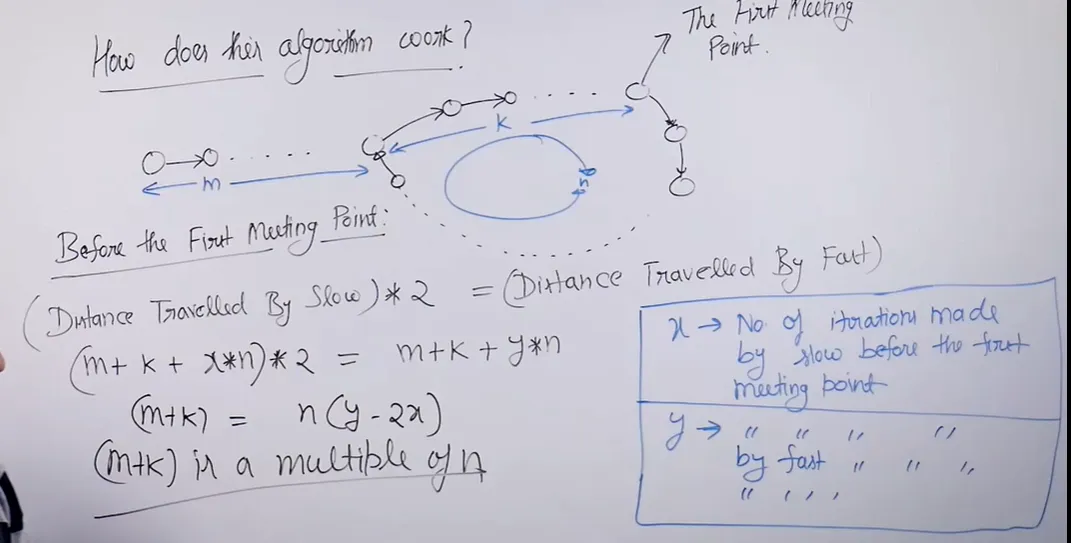
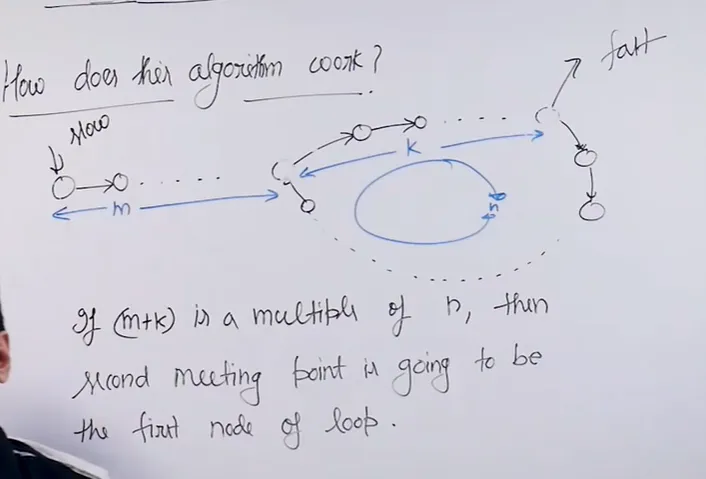
- repeating-element ( Contains maths derivation )
- find-duplicate-number
Floyd’s Duplicate Detection — Key Insights
Tags: #floyd-cycle-detection #fast-and-slow-pointers #two-pointers #arrays #duplicates #cycle-detection #functional-graph #pigeonhole-principle #index-mapping #in-place #constant-space #constraints #interview-pattern
Core problem:
n + 1elements, values in[1, n], and exactly one distinct value is duplicated. Find that value in time and auxiliary space.
The Key Transformation
Treat the array as a functional graph:
Every index has exactly one outgoing edge.
Example:
nums = [1, 3, 4, 2, 2]

0 → 1 → 3 → 2 → 4
            ↑     │
            └─────┘
The duplicate value 2 becomes the cycle entrance.
Why Is a Cycle Guaranteed?
There are finitely many nodes, but following next indefinitely:
0 → a → b → c → ... → something already visitedmust eventually revisit a node.
Therefore:
The n+1 elements and values restricted to [1,n] guarantee the structure needed for the duplicate to correspond to this cycle.
Why Does the Duplicate Become the Cycle Entrance?
Suppose d is the duplicated value:
nums[i] = d
nums[j] = d
Then:
i ──┐
    ├──→ d
j ──┘
Multiple indices point to the same node d.
Once paths merge, they cannot diverge because every node has only one outgoing edge.
Thus the traversal eventually enters a cycle through d.
Important Subtlety: Duplicate More Than Twice
The duplicated value does not have to occur exactly twice.
Example:
[1, 3, 4, 2, 2, 2]2 occurs three times, but there is still only one distinct duplicated value.
The extra occurrences simply create additional incoming edges:
3 ──┐
4 ──┼──→ 2 → ...
5 ──┘
They do not become additional parts of the cycle.
Therefore
Exactly one distinct duplicate
    ↓
May occur 2, 3, 4, ... times
    ↓
Floyd can still identify it
What breaks the unique-answer guarantee is multiple distinct duplicated values:
[2, 1, 3, 2, 3]
         ↑     ↑
       duplicate values: 2 and 3
Floyd’s Two Phases
Phase 1 — Detect a meeting point
slow = fast = 0

while True:
    slow = nums[slow]
    fast = nums[nums[fast]]

    if slow == fast:
        break
This finds some point inside the cycle.
It is not necessarily the duplicate.
Phase 2 — Find cycle entrance
slow = 0

while slow != fast:
    slow = nums[slow]
    fast = nums[fast]

return slow
They meet at the cycle entrance = duplicate value.
Why This Pattern Is Important
The real interview insight isn’t:
“Use Floyd whenever you see duplicates.”
Instead:
Array
  ↓
nums[i] can act as next pointer?
  ↓
Functional graph
  ↓
Repeated state
  ↓
Cycle detection
  ↓
Floyd
This same transformation can appear in problems that don’t initially look like linked-list problems.
Constraint Checklist
Think Floyd when you see:
-
n + 1elements -
values in
[1, n] -
exactly one distinct duplicated value
-
array modification prohibited
-
auxiliary space required
Don’t blindly use Floyd
If there are multiple distinct duplicates or the value range doesn’t support the index mapping, use another technique such as hashing, counting, sorting, or a problem-specific approach.
Key Takeaways
-
Array → functional graph is the crucial transformation.
-
Finite nodes + one outgoing edge ⇒ eventual cycle.
-
The duplicated value is the cycle entrance.
-
The duplicate may occur more than twice; only one distinct duplicated value is required.
-
Extra occurrences create additional incoming edges, not additional cycle nodes.
-
Multiple distinct duplicated values invalidate the unique cycle-entrance interpretation.
-
Phase 1 finds the cycle; Phase 2 finds its entrance.
Mental hook:
“Don’t see an array of numbers—see nodes withnums[i]as their next pointer.”
Important Footnotes
🧠 Floyd’s Cycle Detection: The “Index 0” Insight (LC 287)
📌 The Core Question
In LeetCode 287 (Find the Duplicate Number), why are values strictly bounded between while indices span ? Why does no element ever point to 0?
🔑 The Insight
Index 0 is intentionally engineered to be the external launchpad (the tail) of the graph.
Because 0 is a valid starting index but never appears as a value inside the array, no element can ever point back to index 0.
🚀 Why This Matters (The Mechanics)
1. Guarantees a -shaped (Rho) Graph
- With
0excluded from values: The graph must have a tail leading into a loop (-shape). - If
0were included: The graph could form a perfect loop (-shape) with no tail.
2. Enables Phase 2 (Finding the Duplicate)
Floyd’s algorithm relies on a strict mathematical distance relationship to find the cycle entrance:
- Because
0is guaranteed to be outside the loop, resetting a pointer to0in Phase 2 ensures the two pointers will meet exactly at the loop entrance (the duplicate value). - Without a tail, Phase 2 fails because you cannot step into an entrance from the outside. [6]
3. Proof of Duplicate Existence
If an array had no tail (a perfect circle), it would be a perfect permutation where every number appears exactly once. The exclusion of 0 from the values forces a bottleneck, mathematically guaranteeing that a duplicate must exist to bridge the tail into a loop. [7]
Maths
Before first meeting point
(Distance travelled by slow pointer) * 2 = Distance travelled by fast pointer