Heaps
See Also :-
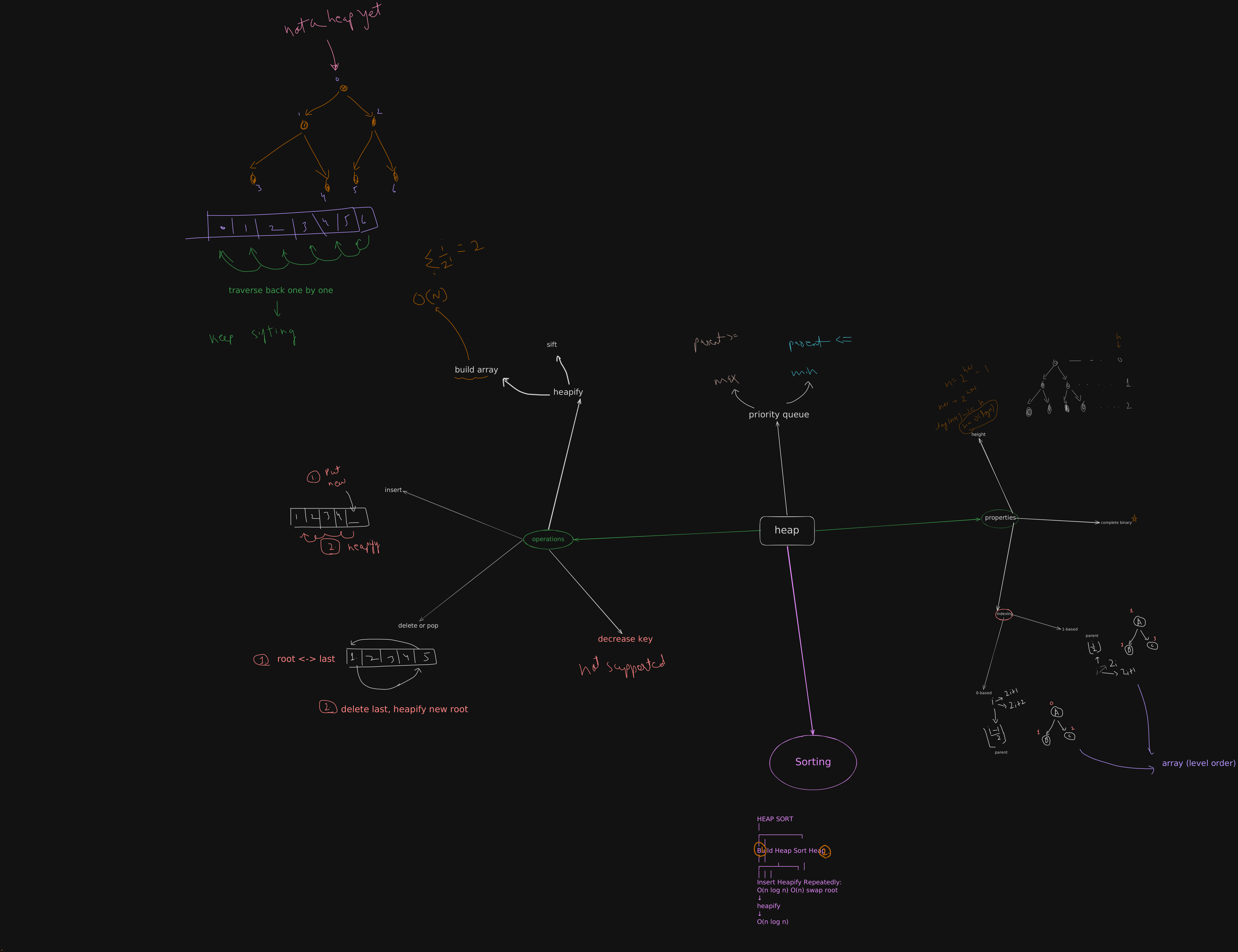
Heaps — Complete PKM / DSA Note
Tags: #DSA #Heaps #BinaryHeap #MinHeap #MaxHeap #PriorityQueue #CompleteBinaryTree #HeapProperty #Heapify #SiftUp #SiftDown #BuildHeap #HeapSort #Sorting #ArrayRepresentation #TreeDataStructure #Greedy #GraphAlgorithms #Dijkstra #Prim #KthElement #TopK #DataStructures #TimeComplexity
Core idea: A binary heap is a complete binary tree stored efficiently in an array, with an ordering constraint between every parent and its children.
A max-heap keeps the largest element at the root; a min-heap keeps the smallest element at the root.
1. What is a Heap?
A heap is a specialized tree-based data structure primarily used when we repeatedly need access to the minimum or maximum element.
A binary heap has two defining properties:
1. Structural property
The tree must be a Complete Binary Tree (CBT).
A complete binary tree means:
-
Every level is completely filled except possibly the last.
-
The last level is filled from left to right.
Example:
        10
       /  \
      7    8
     / \  /
    3  5 6
This is complete because the final level is filled from left to right.
But:
        10
       /  \
      7    8
       \
        5
is not complete because there is a gap on the left before a node appears on the right.
2. Heap-order property
The relationship between a parent and its children must satisfy the heap condition.
For a Max Heap:
parent >= childrenFor a Min Heap:
parent <= childrenExample of max-heap:
          50
        /    \
      30      40
     /  \    /  \
   10   20  35   25
Every parent is greater than or equal to its children.
Example of min-heap:
          5
        /   \
       10    8
      / \   / \
     20 15 12 30
Every parent is less than or equal to its children.
2. The Two Properties Must Be Kept Separate
This distinction is extremely important.
A heap is valid only when both conditions hold:
                    HEAP
                     |
          +----------+----------+
          |                     |
   Complete Tree          Heap Ordering
   (shape property)       (value property)
For example:
          10
        /    \
       20     30
The shape is complete.
But it is not a min-heap, because:
10 <= 20 ✅
10 <= 30 ✅
Actually, it is a min-heap.
Now:
          30
        /    \
       10     20
The shape is complete, but:
30 >= 10 ❌ for min-heap
30 >= 20 ❌ for min-heap
It is, however, a valid max-heap.
So:
Complete binary tree determines where nodes are allowed to exist. Heap order determines which values are allowed where.
3. Why Do We Use a Heap?
Suppose we want:
“Give me the largest element repeatedly.”
A normal unsorted array gives:
[4, 1, 9, 2, 7, 5]Finding the maximum requires:
O(n)A heap organizes the data so that the important element is always at the root:
          9
        /   \
       7     5
      / \   /
     2   1 4
Therefore:
maximum = root = O(1)And when the maximum is removed, the heap can be restored in:
O(log n)This is why heaps are extremely useful for priority queues.
4. A Heap Is Usually Stored in an Array
Although we conceptually think of a heap as a tree, we usually do not create tree nodes with pointers.
Instead, we store it in an array.
Example:
Tree:

          50
        /    \
      30      40
     /  \    /  \
   10   20  35   25


Array:

[50, 30, 40, 10, 20, 35, 25]
This works because the tree is complete.
There are no arbitrary gaps, so every node’s position can be determined mathematically.
5. Array Index Relationships
This is one of the most important things to memorize.
For 0-based indexing:
           i
         /   \
      left   right

left  = 2*i + 1
right = 2*i + 2

parent = (i - 1) // 2
Example:
Array:

index:  0   1   2   3   4   5   6
value: 50  30  40  10  20  35  25
For index 1:
value = 30

left  = 2(1)+1 = 3   -> 10
right = 2(1)+2 = 4   -> 20
For index 5:
value = 35

parent = (5-1)//2
       = 2

arr[2] = 40
So:
             40
             |
            35
6. Why the Array Representation Is So Efficient
A general binary tree may require pointers:
Node
 ├── left
 └── right
A heap does not need those pointers because the structure is guaranteed to be complete.
The tree structure is implicitly encoded in the indices.
This gives us:
-
contiguous memory
-
no explicit pointer overhead
-
simple parent/child calculations
-
excellent cache locality in practice
-
easy implementation
This is one of the key reasons heaps are commonly implemented using arrays.
7. Min Heap vs Max Heap
Max Heap
The greatest element is at the root.
         MAX
        /   \
      ...   ...
Condition:
parent >= childTherefore:
heap[0]contains the maximum.
Min Heap
The smallest element is at the root.
         MIN
        /   \
      ...   ...
Condition:
parent <= childTherefore:
heap[0]contains the minimum.
Important Observation
A heap does not mean:
entire array is sortedA max heap:
[50, 30, 40, 10, 20, 35, 25]is valid even though:
30 > 40 ❌as a left-to-right array ordering.
The only requirement is parent-child ordering.
This is one of the most common beginner misconceptions.
8. Heap ≠ Binary Search Tree
They are both binary trees, but their ordering rules are very different.
Binary Search Tree
For every node:
left subtree < node < right subtreeExample:
       10
      /  \
     5   20
The left side and right side have global ordering implications.
Heap
Only parent-child priority matters:
       10
      /  \
     20  15
This can be a max/min heap depending on the values, but there is no requirement that the entire left subtree be less than the right subtree.
Therefore:
BST gives strong ordering across subtrees. Heap gives local parent-child ordering.
9. Height of a Heap
A heap is a complete binary tree.
For n nodes:
height = O(log n)More precisely:
height = floor(log₂ n)approximately.
Why is this important?
Because the main heap operations move an element up or down the tree, and the maximum distance it can travel is the tree’s height.
Therefore:
sift up   -> O(log n)
sift down -> O(log n)
10. Core Heap Operations
The major operations shown in your mind map are:
                 HEAP
                   |
              OPERATIONS
             /     |      \
         insert   delete   heapify
                     |
                decrease key
The most important operations are:
| Operation | Complexity |
|---|---|
| Peek root | O(1) |
| Insert | O(log n) |
| Extract/Delete root | O(log n) |
| Heapify one node | O(log n) |
| Build heap | O(n) |
| Search arbitrary element | O(n) |
| Heap Sort | O(n log n) |
The reason the common operations are fast is that the heap only needs to maintain ordering along a single root-to-leaf path.
11. Insertion into a Heap
Suppose we have a max heap:
          50
        /    \
      30      40
     /  \    /
    10  20  35
Array:
[50, 30, 40, 10, 20, 35]Now insert:
45Step 1 — Put the new element at the end
Because the tree must remain complete:
          50
        /    \
      30      40
     /  \    / \
    10  20  35 45
Array:
[50, 30, 40, 10, 20, 35, 45]The shape property is preserved.
But heap order is violated:
40 < 4512. Sift Up / Bubble Up
We compare the new node with its parent.
45
|
parent = 40
Since:
45 > 40swap them.
          50
        /    \
      30      45
     /  \    / \
    10  20  35 40
Now compare:
45 with parent 50Since:
45 < 50stop.
Final heap:
          50
        /    \
      30      45
     /  \    / \
    10  20  35 40
Insertion Algorithm
def insert(heap, value):
    heap.append(value)

    i = len(heap) - 1

    while i > 0:
        parent = (i - 1) // 2

        if heap[parent] >= heap[i]:
            break

        heap[parent], heap[i] = heap[i], heap[parent]
        i = parent
This implementation is for a max heap.
For a min heap, reverse the comparison:
if heap[parent] <= heap[i]:
    break
13. Why Insertion Is O(log n)
We initially insert at:
leafThen the element can move:
leaf
 ↓
parent
 ↓
grandparent
 ↓
...
 ↓
root
At most, it travels one tree height.
Since:
height = O(log n)we get:
Insertion = O(log n)14. Extract / Delete the Root
Suppose:
          50
        /    \
      30      45
     /  \    / \
    10  20  35 40
We want to remove:
50We cannot simply remove the root because then the tree structure would become invalid.
Instead:
Step 1
Replace the root with the last element:
          40
        /    \
      30      45
     /  \    /
    10  20  35
Array:
[40, 30, 45, 10, 20, 35]The tree is still complete.
But heap order is broken:
40 < 4515. Sift Down / Heapify Down
Compare the root with its children.
        40
       /  \
      30  45
For a max heap, choose the larger child.
45 > 30Swap:
          45
        /    \
      30      40
     /  \    /
    10  20  35
Now 40 has child 35:
40 >= 35So stop.
Final heap:
          45
        /    \
      30      40
     /  \    /
    10  20  35
16. Why Do We Compare With the Larger Child?
This is a subtle but extremely important point.
For a max heap, suppose:
        X
       / \
      40  50
If:
X = 45we cannot swap with 40, because then:
       40
      /  \
     45  50
and the parent 40 would still be smaller than 50.
So we choose:
larger childbecause that child is the one that must become the parent.
Similarly:
Max heap
choose larger childMin heap
choose smaller childThis is a very useful interview rule.
17. Extract-Max Algorithm
def extract_max(heap):
    if not heap:
        raise IndexError("extract_max from empty heap")

    if len(heap) == 1:
        return heap.pop()

    maximum = heap[0]

    heap[0] = heap.pop()

    i = 0

    while True:
        left = 2 * i + 1
        right = 2 * i + 2
        largest = i

        if left < len(heap) and heap[left] > heap[largest]:
            largest = left

        if right < len(heap) and heap[right] > heap[largest]:
            largest = right

        if largest == i:
            break

        heap[i], heap[largest] = heap[largest], heap[i]
        i = largest

    return maximum
Complexity:
O(log n)18. The Two Fundamental Repair Operations
Most heap algorithms can be understood through just two ideas:
                HEAP REPAIR
                /         \
           SIFT UP      SIFT DOWN
Sift Up
Used when:
new value enters at the bottomTypical operation:
insertMovement:
bottom → rootSift Down
Used when:
root/internal node may be too large/smallTypical operations:
extract root
heapify
build heap
heap sort
Movement:
top → bottomThis mental model is more important than memorizing individual implementations.
19. Peek
The root always contains the highest-priority element.
Therefore:
Max Heap
heap[0]gives maximum.
Min Heap
heap[0]gives minimum.
Complexity:
O(1)No restructuring is necessary.
20. Delete an Arbitrary Element
Suppose:
[50, 40, 45, 20, 30, 35, 10]We want to delete:
30A common strategy is:
-
Find the element.
-
Replace it with the last element.
-
Remove the last element.
-
Restore heap order.
The repair direction depends on the replacement value.
For example:
      40
     /  \
   30    45
Replace 30 with some value X.
We must ask:
Does X violate the relationship with its parent?If yes:
sift upOtherwise check:
Does X violate the relationship with its children?If yes:
sift downTherefore:
After replacing an element, the replacement needs to move in the direction of the violation.
21. Decrease-Key / Increase-Key
These operations are important in many heap-based algorithms.
For a min heap:
decrease-keymakes an element smaller.
Since smaller values have higher priority, it may need to move up.
decrease key
     ↓
possibly violates parent relationship
     ↓
sift up
For a min heap:
increase-keymay cause the element to move down.
Conversely, for a max heap:
increase-key → sift up
decrease-key → sift down
22. Build Heap
One of the most important heap concepts is:
How do we convert an arbitrary array into a heap?
Suppose:
arr = [4, 10, 3, 5, 1]We want a max heap.
The naive approach would be:
insert elements one by oneThis gives:
O(n log n)But there is a better method:
BUILD HEAP = O(n)23. Bottom-Up Build Heap
For an array:
[4, 10, 3, 5, 1]The tree is:
          4
        /   \
      10     3
     /  \
    5    1
The leaves already satisfy heap order internally because they have no children.
Therefore, we start from the last non-leaf node.
For 0-based indexing:
last_non_leaf = n // 2 - 1Then:
i = n//2 - 1
i -= 1
i -= 1
...
i = 0
At each index, perform:
sift down24. Why Do We Start at n//2 - 1?
For 0-based indexing:
left = 2i + 1A node is a leaf when:
2i + 1 >= nThe last non-leaf therefore occurs at:
floor(n/2) - 1So:
for i in range(n // 2 - 1, -1, -1):
    sift_down(i)
is the classic bottom-up heap construction.
25. Example of Build Heap
Take:
[4, 10, 3, 5, 1]Tree:
          4
        /   \
      10     3
     /  \
    5    1
Start from:
index = 1Node:
10Children:
5, 1Already valid as max-heap subtree:
10 >= 5
10 >= 1
Now:
index = 0Node:
4Children:
10, 3Largest child:
10Swap:
          10
        /    \
       4      3
      / \
     5   1
Now 4 has child 5.
Swap again:
          10
        /    \
       5      3
      / \
     4   1
Final array:
[10, 5, 3, 4, 1]This is a valid max heap.
26. Why Is Build Heap O(n), Not O(n log n)?
This is a famous DSA interview question.
At first glance, we might think:
n nodes × O(log n)
= O(n log n)
But this is an overestimate.
Most nodes are near the bottom of the tree, so they can only move a tiny distance.
Only a very small number of nodes are capable of moving close to the root.
Conceptually:
         1 node        → height
       2 nodes         → height - 1
       4 nodes         → height - 2
       8 nodes         → height - 3
       ...
      many leaves      → height 0
The total work is:
O(n)This is a very important heap fact:
Bottom-up build heap runs in linear time: O(n).
27. Build Heap vs Repeated Insertion
Two ways to construct a heap:
Method 1 — Repeated insertion
insert one element at a timeComplexity:
O(n log n)Method 2 — Bottom-up heapify
sift down from last non-leaf to rootComplexity:
O(n)Therefore:
When you already have all elements in an array, bottom-up build heap is preferable.
28. Heapify
The word heapify can be confusing because different textbooks use it slightly differently.
Usually, heapify means:
Restore the heap property for a node/subtree, assuming its child subtrees already satisfy the heap property.
For a max heap:
def heapify(heap, n, i):
    largest = i

    left = 2 * i + 1
    right = 2 * i + 2

    if left < n and heap[left] > heap[largest]:
        largest = left

    if right < n and heap[right] > heap[largest]:
        largest = right

    if largest != i:
        heap[i], heap[largest] = heap[largest], heap[i]
        heapify(heap, n, largest)
This is essentially sift down.
Complexity:
O(log n)for one node.
29. Priority Queue
One of the most important real-world uses of a heap is implementing a priority queue.
A normal queue:
FIFO

A → B → C → D
The first inserted element is served first.
A priority queue instead says:
The element with the highest priority gets served first.
Example:
Patient A → priority 3
Patient B → priority 10
Patient C → priority 5
The service order may be:
B
C
A
A heap is perfect for this.
Max heap
Highest value = highest priority.
Min heap
Lowest value = highest priority.
30. Python’s heapq
Python’s standard library provides:
import heapqIt implements a min heap.
Example:
import heapq

heap = []

heapq.heappush(heap, 5)
heapq.heappush(heap, 2)
heapq.heappush(heap, 8)
heapq.heappush(heap, 1)

print(heap)
The exact internal array is not a sorted array, but:
heap[0]is always the minimum.
print(heap[0])
# 1
31. Removing From Python’s Heap
minimum = heapq.heappop(heap)

print(minimum)
This removes and returns the smallest element.
Complexity:
heappop = O(log n)Insertion:
heapq.heappush(heap, x)Complexity:
O(log n)Peek:
heap[0]Complexity:
O(1)32. Creating a Heap From an Existing Array
Python provides:
heapq.heapify(arr)Example:
arr = [10, 4, 7, 1, 3, 8]

heapq.heapify(arr)
Now arr is arranged as a min heap.
Complexity:
O(n)This directly corresponds to the bottom-up build heap concept.
33. How to Implement a Max Heap Using heapq
Since heapq is a min heap, a common trick is to insert negative values:
import heapq

heap = []

heapq.heappush(heap, -50)
heapq.heappush(heap, -20)
heapq.heappush(heap, -80)

maximum = -heapq.heappop(heap)

print(maximum)
# 80
Because:
minimum(-value) = -maximum(value)34. Heap Sort
A heap can also be used to sort an array.
This is the sorting concept represented in your mind map:
                     HEAP
                       |
                    SORTING
                       |
                  HEAP SORT
                  /       \
            Build Heap    Repeatedly
                           remove root
Heap sort has two major phases:
1. Build heap
2. Repeatedly extract root
35. Heap Sort With a Max Heap
Suppose:
arr = [4, 10, 3, 5, 1]Step 1 — Build max heap
[10, 5, 3, 4, 1]Step 2 — Put largest element into final position
Largest:
10Swap root with last element:
[1, 5, 3, 4, 10]Now the last position is finalized.
Heapify only the unsorted portion:
[1, 5, 3, 4 | 10]Heapify:
[5, 4, 3, 1 | 10]Repeat:
[1, 4, 3, 5 | 10]heapify:
[4, 1, 3, 5 | 10]Continue until:
[1, 3, 4, 5, 10]Therefore:
Max heap + repeatedly place root at end
= ascending order
36. Why Does Max-Heap Heap Sort Produce Ascending Order?
A max heap always gives:
largest remaining elementat the root.
So each extraction gives:
largest
second largest
third largest
...
We place those at the end:
            sorted
              ↓
[ ?, ?, ?, ?, 10]
then:
[ ?, ?, ?, 5, 10]then:
[ ?, ?, 4, 5, 10]Eventually:
[1, 3, 4, 5, 10]37. Heap Sort Complexity
Build heap:
O(n)Then n-1 extractions:
O(log n) eachTherefore:
O(n log n)Overall:
Time = O(n log n)Importantly:
Worst case = O(n log n)
Average = O(n log n)
Best = O(n log n)
Heap sort has guaranteed O(n log n) time.
38. Is Heap Sort In-Place?
Yes.
A standard array-based heap sort can sort the array without requiring another array proportional to n.
Therefore:
Auxiliary space = O(1)apart from the implementation’s recursion/stack details.
A common iterative heapify implementation therefore gives:
Time  = O(n log n)
Space = O(1)
39. Is Heap Sort Stable?
No.
Heap sort is generally:
NOT stableThat means two equal elements do not necessarily preserve their original relative order.
So the usual comparison is:
| Algorithm | Time | Extra Space | Stable? |
|---|---|---|---|
| Merge Sort | O(n log n) | O(n) | Yes |
| Quick Sort | average O(n log n) | usually O(log n) | No |
| Heap Sort | O(n log n) | O(1) | No |
Heap sort’s major advantage is:
guaranteed O(n log n) + O(1) auxiliary space40. Full Heap Sort Implementation
def heapify(arr, n, i):
    """Restore max-heap property for subtree rooted at i."""
    largest = i

    left = 2 * i + 1
    right = 2 * i + 2

    if left < n and arr[left] > arr[largest]:
        largest = left

    if right < n and arr[right] > arr[largest]:
        largest = right

    if largest != i:
        arr[i], arr[largest] = arr[largest], arr[i]
        heapify(arr, n, largest)


def heap_sort(arr):
    n = len(arr)

    # 1. Build max heap
    for i in range(n // 2 - 1, -1, -1):
        heapify(arr, n, i)

    # 2. Repeatedly move maximum to the end
    for end in range(n - 1, 0, -1):
        arr[0], arr[end] = arr[end], arr[0]

        # Heap size becomes smaller
        heapify(arr, end, 0)

    return arr
Example:
arr = [4, 10, 3, 5, 1]

heap_sort(arr)

print(arr)
# [1, 3, 4, 5, 10]
41. A Crucial Heap Sort Detail: Heap Size Shrinks
This is easy to overlook.
Suppose:
[10, 7, 8, 3, 5 | 9, 11]Once an element has been placed into the sorted region:
                  heap       sorted
                   ↓            ↓
[10, 7, 8, 3, 5 | 9, 11]
The sorted elements are no longer part of the heap.
So heapify uses:
heapify(arr, end, 0)instead of:
heapify(arr, len(arr), 0)end represents the current heap size.
This is one of the central implementation details of heap sort.
42. Complete Binary Tree Level Order ↔ Array
Your mind map also emphasizes the relationship between the tree and array.
Consider:
          10
        /    \
       7      8
      / \    / \
     3   5  6   4
Level-order traversal:
10
7 8
3 5 6 4
Array representation:
[10, 7, 8, 3, 5, 6, 4]So the array corresponds directly to:
level-order traversalThis is why parent and child indices have such simple formulas.
43. Why Can’t We Use an Array for Any Arbitrary Binary Tree?
Because an arbitrary binary tree may contain gaps.
Example:
        A
       /
      B
       \
        C
To represent this directly in an array using heap-style indexing:
A -> 0
B -> 1
C -> 4
We already have wasted positions:
[A, B, ?, ?, C]For a highly sparse tree this becomes extremely wasteful.
A heap avoids this problem because its tree is always:
completeTherefore the array representation stays compact.
44. Height vs Number of Nodes
For a complete binary tree:
height ≈ log₂(n)This is the mathematical foundation of heap efficiency.
At each level the number of nodes approximately doubles:
Level 0 → 1
Level 1 → 2
Level 2 → 4
Level 3 → 8
...
Total nodes through height h:
1 + 2 + 4 + ... + 2^hwhich gives:
2^(h+1) - 1So:
n ≈ 2^hand therefore:
h ≈ log₂ n45. Searching in a Heap
A common misconception is:
“Since a heap is ordered, searching should be O(log n).”
Not necessarily.
A heap only guarantees:
parent-child orderingIt does not provide enough global ordering to perform binary-search-style elimination.
Therefore searching for an arbitrary value can require:
O(n)in the worst case.
This is an important distinction:
BST search → potentially O(log n)
Heap search → O(n)
assuming the usual balanced BST conditions for the former.
46. What a Heap Does NOT Give You
A heap is excellent at:
minimum / maximumBut it is not designed to efficiently answer:
"Where is value 73?"nor:
"Give me every element in sorted order immediately."without performing additional work.
So choose a heap when the requirement is:
Repeated access to the highest-priority element.
Not:
Maintain full sorted ordering.
47. Heap as a Priority Structure
A useful abstraction is:
              HEAP
                |
        "Who has highest priority?"
                |
                ↓
              ROOT
For max heap:
priority = larger valueFor min heap:
priority = smaller valueBut priority does not have to literally be the number itself.
For example:
(priority, task)can be stored in a min heap.
Example:
(1, "Fix production bug")
(2, "Reply to email")
(5, "Watch tutorial")
The smallest priority number can represent the highest priority.
48. Heap Applications
Heaps appear everywhere in DSA because many algorithms repeatedly need the smallest/largest candidate.
Priority Queues
The canonical application.
Insert item
Extract highest priority
Dijkstra’s Algorithm
Repeatedly select the vertex with the smallest currently known distance.
minimum distance
        ↓
   min heap / PQ
Prim’s Algorithm
Repeatedly select the minimum-weight edge/vertex candidate.
Again:
minimum priority
        ↓
      heap
Top-K Problems
Examples:
Find K largest elements
Find K smallest elements
Top K frequent elements
K closest points
A heap lets us maintain only the candidates we care about.
Kth Largest / Kth Smallest
A heap is often an intuitive solution.
For example, to find the k largest elements, maintain a min heap of size k.
When the heap grows beyond k:
pop smallestThe root eventually represents:
k-th largestScheduling
Tasks can be selected according to:
priority
deadline
cost
execution time
Merge K Sorted Lists
A heap can keep the smallest current element from each list.
list 1 → current element
list 2 → current element
list 3 → current element
...
            ↓
          min heap
            ↓
       smallest overall
This gives an efficient multiway merge.
49. The “K Largest” Heap Pattern
Suppose:
arr = [7, 2, 9, 4, 1, 8, 5]
k = 3
We want:
[9, 8, 7]Use a min heap of size k.
Process:
7 → [7]
2 → [2,7]
9 → [2,7,9]
Now process:
4Heap becomes four elements temporarily:
[2,4,7,9]Remove the smallest:
[4,7,9]Continue:
1 → discard
8 → [7,8,9]
5 → discard
Final heap:
[7, 8, 9]The root:
7is the 3rd largest.
Complexity:
O(n log k)instead of necessarily sorting all elements:
O(n log n)This is a very important interview pattern.
50. A Useful Rule for Top-K Problems
Memorize the following intuition:
Find K largest
Usually:
min heap of size KWhy?
Because the root is the smallest among the current K largest candidates, so it is the first candidate we can throw away.
Find K smallest
Usually:
max heap of size KWhy?
Because the root is the largest among the current K smallest candidates, so it is the easiest one to discard.
This “opposite heap” pattern is extremely useful.
51. Heapify Direction — A Mental Framework
Instead of blindly memorizing:
insert = sift up
delete = sift down
think about where the violation exists.
If the value may be too powerful relative to its parent:
move upwardIf the value may be too powerful relative to its children:
move downwardSo:
             Violation
                 |
        +--------+--------+
        |                 |
    Parent issue      Child issue
        |                 |
    Sift Up          Sift Down
This is much easier to generalize.
52. Recursive vs Iterative Heapify
Heapify can be implemented recursively:
def heapify(arr, n, i):
    largest = i

    left = 2 * i + 1
    right = 2 * i + 2

    if left < n and arr[left] > arr[largest]:
        largest = left

    if right < n and arr[right] > arr[largest]:
        largest = right

    if largest != i:
        arr[i], arr[largest] = arr[largest], arr[i]
        heapify(arr, n, largest)
Or iteratively:
def heapify(arr, n, i):
    while True:
        largest = i

        left = 2 * i + 1
        right = 2 * i + 2

        if left < n and arr[left] > arr[largest]:
            largest = left

        if right < n and arr[right] > arr[largest]:
            largest = right

        if largest == i:
            break

        arr[i], arr[largest] = arr[largest], arr[i]
        i = largest
The iterative version avoids recursion overhead and can be preferable in production code.
53. Common Heap Mistakes
Mistake 1 — Thinking a heap is sorted
Incorrect:
[50, 40, 45, 10, 20, 30]does not need to be:
[50,45,40,30,20,10]Only heap order is required.
Mistake 2 — Forgetting completeness
Heap structure is not just:
parent >= childIt must also be:
complete binary treeMistake 3 — Choosing the wrong child during sift down
For max heap:
choose larger childFor min heap:
choose smaller childMistake 4 — Heapifying leaf nodes unnecessarily
Leaves cannot violate their children’s relationship because:
they have no childrenSo bottom-up build heap starts at:
n // 2 - 1Mistake 5 — Thinking build heap is O(n log n)
Bottom-up build heap is:
O(n)This is a classic interview question.
Mistake 6 — Searching like binary search
A heap is not globally sorted.
Arbitrary search:
O(n)Mistake 7 — Forgetting the heap size in heap sort
After placing the root at the end:
sorted portion grows
heap portion shrinks
Therefore heapify should operate only on the remaining heap.
54. Complexity Cheat Sheet
| Operation | Time |
|---|---|
| Peek min/max | O(1) |
| Insert | O(log n) |
| Extract min/max | O(log n) |
| Sift up | O(log n) |
| Sift down | O(log n) |
| Delete root | O(log n) |
| Delete arbitrary value* | O(n) to find + O(log n) repair |
| Search arbitrary value | O(n) |
| Build heap | O(n) |
| Heap Sort | O(n log n) |
*If the element’s index is already known, deletion can be O(log n).
55. The Most Important Complexity Insight
There are three different questions:
“Give me min/max.”
O(1)Because it’s always the root.
“Add something.”
O(log n)Because it may travel from leaf to root.
“Remove min/max.”
O(log n)Because the replacement may travel from root to leaf.
This single framework explains most heap complexity.
56. Heap vs Other Data Structures
| Requirement | Suitable Structure |
|---|---|
| Fast arbitrary lookup | Hash Table |
| Ordered search | BST / Balanced BST |
| Min/max repeatedly | Heap |
| FIFO | Queue |
| LIFO | Stack |
| Fast insertion/removal at ends | Deque |
| Full sorting | Sorting algorithm |
The heap occupies a very specific niche:
Maintain a dynamically changing collection while efficiently exposing the highest-priority element.
57. A Heap Is Not Just “A Tree”
The deeper idea is that a heap provides a partial ordering.
Consider:
          100
        /     \
       50      70
      / \     / \
    20  40   30 60
We know:
100 > 50
100 > 70
50 > 20
50 > 40
70 > 30
70 > 60
But do we know:
50 > 70No.
And do we know:
20 > 30No.
So a heap is partially ordered, not fully sorted.
This is precisely why:
peek max/min → very fastwhile:
arbitrary search → not especially fast58. The Central Mental Model
Try to think about a heap as:
                    HEAP
                      |
            "Keep the best item
               at the top"
                      |
             +--------+--------+
             |                 |
          Structure          Ordering
             |                 |
        Complete tree      Parent-child
             |                 |
          Array          Min / Max property
Then operations become natural:
INSERT
   ↓
place at next available position
   ↓
sift up


EXTRACT ROOT
   ↓
move last element to root
   ↓
sift down


BUILD HEAP
   ↓
start from last non-leaf
   ↓
sift down toward root


HEAP SORT
   ↓
build heap
   ↓
move root to sorted region
   ↓
sift down
   ↓
repeat
59. Complete Binary Tree vs Full vs Perfect
These terms are often confused in interviews.
Full Binary Tree
Every node has either:
0 childrenor:
2 childrenNever exactly one child.
Complete Binary Tree
All levels are full except possibly the last, and the last is filled left-to-right.
This is the structural requirement of a binary heap.
Perfect Binary Tree
Every internal node has exactly two children and all leaves are at the same level.
Example:
          1
       /     \
      2       3
     / \     / \
    4   5   6   7
Every perfect binary tree is complete, but not every complete binary tree is perfect.
60. One Fully Worked Example
Let’s construct a max heap by inserting:
10, 4, 15, 20, 0, 8Insert 10
[10]Insert 4
[10, 4]Insert 15
Before repair:
[10, 4, 15]Since:
15 > 10swap:
[15, 4, 10]Insert 20
Before:
[15, 4, 10, 20]Compare with parent:
20 > 4swap:
[15, 20, 10, 4]Now:
20 > 15swap:
[20, 15, 10, 4]Insert 0
[20, 15, 10, 4, 0]Already valid.
Insert 8
[20, 15, 10, 4, 0, 8]Parent:
10Since:
10 > 8stop.
Final:
[20, 15, 10, 4, 0, 8]Tree:
             20
          /      \
        15        10
       /  \      /
      4    0    8
61. Extraction From That Heap
Starting:
[20, 15, 10, 4, 0, 8]Extract 20.
Move last element:
[8, 15, 10, 4, 0]Compare:
8 vs 15 vs 10Largest child:
15Swap:
[15, 8, 10, 4, 0]Now 8 has children:
4, 0Since:
8 >= 4
8 >= 0
stop.
Final:
[15, 8, 10, 4, 0]62. Interview-Level Questions You Should Be Able to Answer
Q: What is a heap?
A complete binary tree satisfying the heap-order property.
Q: Why can a heap be stored in an array?
Because the tree is complete, so parent-child relationships can be derived from indices without pointers.
Q: What is the root of a max heap?
The maximum element.
Q: What is the root of a min heap?
The minimum element.
Q: Why is peek O(1)?
Because the target element is always at index 0.
Q: Why is insertion O(log n)?
The new element is placed at the end and may move up at most one tree height.
Q: Why is extraction O(log n)?
The last element replaces the root and may move down at most one tree height.
Q: Why is build heap O(n)?
Bottom-up heap construction does not perform O(log n) work for every node; most nodes are close to the leaves.
Q: Is a heap sorted?
No. It is only partially ordered.
Q: Can we binary-search a heap?
No, not in general.
Q: Is heap sort stable?
No.
Q: Is heap sort in-place?
Yes, standard array-based heap sort uses O(1) auxiliary space.
63. The Most Important Formulas
For 0-based indexing:
parent(i) = (i - 1) // 2

left(i)   = 2i + 1

right(i)  = 2i + 2
For build heap:
last non-leaf = n // 2 - 1Tree height:
O(log n)Heap operations:
peek      O(1)
insert    O(log n)
extract   O(log n)
build     O(n)
sort      O(n log n)
64. Final Mental Map
                              HEAPS
                                |
              +-----------------+------------------+
              |                                    |
          STRUCTURE                            ORDERING
              |                                    |
     Complete Binary Tree                   Parent-child relation
              |                                    |
      Array representation                 +-------+-------+
              |                            |               |
       index formulas                   MIN HEAP        MAX HEAP
              |                            |               |
     +--------+--------+               min at root     max at root
     |        |        |
   parent    left     right
     |        |        |
 (i-1)//2   2i+1     2i+2


                         OPERATIONS
                              |
          +-------------------+-------------------+
          |                   |                   |
        INSERT            EXTRACT             PEEK
          |                   |                   |
       append            last → root          root
          |                   |
       sift up            sift down
          |
       O(log n)


                       BUILD HEAP
                           |
                 bottom-up heapify
                           |
                     O(n)


                         SORTING
                           |
                       Heap Sort
                           |
               +-----------+-----------+
               |                       |
          Build Heap             Repeatedly
             O(n)               extract root
                                        |
                                    O(n log n)


                     APPLICATIONS
                           |
        +------------------+------------------+
        |                  |                  |
  Priority Queue       Top-K Problems      Graphs
                                         /         \
                                    Dijkstra       Prim
65. Long-Term Learning Takeaway
The most useful way to remember heaps is not as a collection of formulas.
Remember this chain:
Complete tree
      ↓
Can be represented compactly as an array
      ↓
Root can represent the highest priority
      ↓
But modifications can break the heap property
      ↓
Repair locally using sift-up / sift-down
      ↓
Height is O(log n)
      ↓
Insert / Extract become O(log n)
      ↓
Repeated root extraction enables Heap Sort
      ↓
Efficient priority handling enables Priority Queues,
Top-K algorithms, Dijkstra, Prim, scheduling, etc.
The deepest idea is:
A heap sacrifices full ordering in exchange for extremely efficient access to one extreme element—the minimum or maximum.
That trade-off is what makes heaps so useful.
🧠 One-Line Revision
Heap = Complete Binary Tree + Heap Order; array-backed, root gives min/max in O(1), insertion/extraction use sift-up/down in O(log n), bottom-up build is O(n), and repeated extraction gives Heap Sort in O(n log n).